


centro virtual de arte argentino

Menú

Algunos dossiers
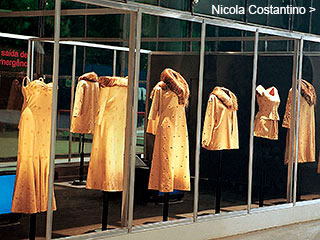
Ropa confeccionada con peletería humana, jabón fabricado con su propia grasa corporal y cañerías obstruidas con potrillos y terneros nonatos. Así se pueden describir algunas de las obras más características de Nicola Costantino, artista rosarina que muestra su producción en los circuitos internacionales más exigentes. Julio Sánchez recorre su vida y su obra.
Marjan Groothuis. “Sculptor’s art rooted in the extreme”, en diario Buenos Aires Herald, 29/9/2002.
production of my work is labour-intensive, I need assistants and a lot of room, which I could not afford anywhere else.” [...]
In 1998, the artist started making balls of varying sizes in aluminium and polyester resin (some were shown in Ruth Benzacar’s stand at arte BA), which bear the imprint of, for example, a cow: “the animal has been comprised into the shape of a circle. Ill that way, order and perfection, which always come with a certain price, are imposed.”
Then, in 2000, Costantino started making friezes (one is exhibited in the MALBA) for which foetuses of calves, colts and or piglets serve as a model. The artist explains that she gets them via friends: “If a pregnant adult animal dies an autopsy is done. The foetus is taken out and given to me so I can use it to make several casts from. I use silicon and polyester resin, but the result looks so real because it is an exact reproduction. The essence of the body is kept because is does not represent my interpretation but a presentation. I assemble the casts in a frieze, which resembles a ditch or maybe even a uterus and again we stumble on ambiguity.” It might sound rather morbid, but Costantino explains that her works are about raising questions: “When does a being become a being? When it is horn, when it is conceived, after flow many months of gestation? We are on a thorny and totally arbitrary path here where answers vary greatly depending on background, religion and culture.”
The artist says that she has several ideas for new works: “I would need a couple of months to think things over but so far this has been impossible because of exhibitions abroad. On the other hand,
continúa

